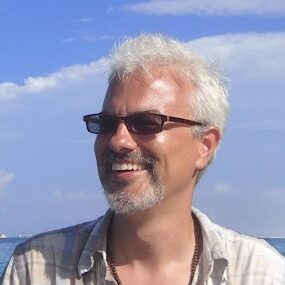
🎓 Professor of Asian History & Health Humanities, Program Chair for Multidisciplinary Studies & Health Humanities
🏛 The Abington College of Pennsylvania State University, 1600 Woodland Rd., Abington PA 19001
📚 Editor in Chief, Asian Medicine: Journal of the International Assoc for the Study of Traditional Asian Medicine
Bio
I call myself a “postdisciplinary scholar of Buddhist medicine.” I have a Ph.D. in History of Medicine from the Johns Hopkins School of Medicine (2010), and am a professor of Asian History and Health Humanities at Penn State University’s Abington College, located near Philadelphia. My research is especially focused on historical and contemporary intersections between health, spirituality, and crosscultural exchange. I also have been the editor in chief of the journal Asian Medicine: Journal of the International Association for the Study of Traditional Asian Medicine since 2016.
Résumé
Education
Ph.D., History of Medicine, Johns Hopkins School of Medicine, 2010. Dissertation title: “Buddhist Medicine in Medieval China: Disease, Healing, and the Body in Crosscultural Translation (2nd to 8th Centuries C.E.).” [Dissertation Review; revised version published in 2014 by University of Pennsylvania Press]. Graduate fields: History of religion and medicine in China; history of religion and medicine in India; history of medicine in the West; Chinese history.
M.A., East Asian Studies, University of Virginia, 2005. Thesis title: “Thai Medicine Reconsidered: ‘Royal’ and ‘Rural’ Practitioners and the Struggle to Define a Tradition.” (Revised version published in 2007 by Hohm Press; 2nd edition 2015 White Lotus Press.)
B.A., University of Virginia, 1996. Majors: Anthropology, Cognitive Science. Minor: East Asian Studies.
Academic Positions
2022–present, Professor of Asian History & Health Humanities, The Abington College of the Penn State University
2016–2022, Associate Professor of Asian History & Religious Studies, Abington College
2010–2016, Assistant Professor of Asian History & Religious Studies, Abington College
2013, Visiting Faculty Fellow, Religion Department, Duke University
2011-12, Regional Faculty Fellow, University of Pennsylvania
2009–10, Instructor, Depts. of History and Religious Studies, Le Moyne College (Syracuse, NY)
2008–09, Visiting scholar, Dharma Drum Buddhist College and Academia Sinica Institute of History & Philology (Taiwan)
2007–08, Instructor, Expository Writing Program and Dept. of History of Science, Medicine, & Technology, Johns Hopkins University
Leadership & Editorial Positions
2022–present, Program Chair for Health Humanities and minor in Bioethics & Medical Humanities.
2017–present, Program Chair for Multidisciplinary Studies, Integrative Arts, and minors in Asian Studies, Global & International Studies, Philosophy, Religious Studies, Women’s Studies.
2016–present, Editor in Chief, Asian Medicine: Journal of the International Association for the Study of Traditional Asian Medicine
2013–present, Council Member, International Association for the Study of Traditional Asian Medicine
2013–2015, Associate Editor, Asian Medicine
2013–14, Book Review Editor (East & Southeast Asia), Asian Medicine
2011–, Founder and organizer, Philadelphia Area Buddhist Studies Workgroup
2011–14, President, Oriental Club of Philadelphia (one of the oldest academic societies in the U.S., 1888-2017)
Major Teaching & Campus Service Awards
2026, Center for Socially Responsible Artificial Intelligence, Teach-a-thon first place
2022–23, Distinguished Honors Faculty
2020, Penn State University Teaching & Learning with Technology Impact Award
2019, Penn State University Teaching & Learning with Technology Faculty Fellow
2018, Teaching Transformation & Innovation Grant, Schreyer Institute for Teaching Excellence
2017, Abington College Ogontz Award (i.e., highest award given to faculty by student body)
2015, Abington College Diversity Award
2015, New Media Consortium Idea Lab Winner for interdisciplinary course on Visualization
2014, Teaching Transformation & Innovation Grant, Schreyer Institute for Teaching Excellence
Major Grants & Research Awards
2026, Robert H. N. Ho Family Foundation Grant ($150K for Contemplative Challenges Collaborative)
2025–27, Program in the Study of Mysticism grant via Emergent Phenomenology Research Consortium (co-recipient of 2-year €250K research funding)
2024, Institute for East-West Medicine Grant ($10K research funding)
2023, Japan Society for the Promotion of Science Invitational Fellowship
2022, Institute for East-West Medicine Grant ($50K research funding)
2019, Penn State University Teaching & Learning with Technology Faculty Fellowship
2016, Abington College Faculty Senate Scholar Award (i.e., “Scholar of the Year”)
2014–17, Global Research Network Program of the National Research Foundation of Korea (co-recipient of 3-year $230K research fellowship)
2013, Duke University Humanities Writ Large Visiting Faculty Fellows
2011–12, Penn Humanities Forum Mellon Regional Faculty Fellowship
2009–10, Charlotte W. Newcombe Doctoral Dissertation Fellowship
2008–09, Fulbright IIE Taiwan with Critical Language Extension Award
My Backstory
I come from a bilingual and transnational Latino family with roots in Colombia, Uruguay, Spain, England, and the US. I spent my early childhood in Canada and Paraguay, moved to the US during elementary school, and spent nearly every summer in Spain. All of this is to say that my interests in crosscultural exchange, translation, and global movements of ideas came to me quite naturally!
I began pursuing my longstanding interest in Asian religion and medicine as an undergraduate majoring in Anthropology and Cognitive Science and minoring in East Asian Studies at the University of Virginia. After graduating in 1996, I lived in Asia for four years — more than two years in Thailand, with extended stays in India, China, and Indonesia as well. During this time, I trained as a practitioner of Traditional Thai Medicine (TTM), and spent time learning hatha–yoga and other Asian healing modalities. I also participated in extended stays at Buddhist meditation centers and monasteries in Northeast Thailand and India, including a summer as ananāgārika (white-robed monastic resident) in a Thai Forest monastery. Although I am neither a yogi nor a Buddhist, I have remained engaged in spiritual practice throughout the rest of my adult life.
While I was working as a practitioner of TTM, I wrote several book about the practice of Thai massage, herbal medicine, and spiritual healing traditions. When I became a graduate student, I left behind clinical practice in order to intensively pursue academic approaches to Asian medicine. I returned to the University of Virginia in 2002 to pursue a Master’s Degree in East Asian Studies. My thesis explored the cultural influences that led to the creation of modern TTM. In 2005, I entered the Ph.D. program in the History of Medicine at Johns Hopkins, where I completed fields in the global history of medicine with emphasis on the relationship between Buddhism and medicine in medieval China.
I joined the faculty at Abington College in 2010, where I have taught a range of undergraduate courses on Asian history, religions, health humanities, and related topics. I have a true passion for teaching, and it is my strong belief that the humanities are indispensable in providing undergraduates important tools to develop empathy and meaning. I have also been particularly involved in teaching innovations that promote the use of new technology in the curriculum.
My teaching methods have been influenced by several key experiences in my professional development. The first was my year as an instructor in the expository writing program at Johns Hopkins, which taught me the Harvard “Expos” pedagogical method. The second was my year-long fellowship at LeMoyne College, where I encountered the Jesuit philosophy of cura personalis (educating the whole person) and the grading method of “learning contracts.” Finally, my time at Abington College, a minority-majority institution with an extremely diverse student body, has also challenged me to expand and refine my teaching methods with a strong focus on student success and engagement. I call my approach to teaching “a pedagogy of the soul,” which I have written about in my blog, Human•ities. I wonder how we can contribute to healing, community building, empathy, and spiritual renewal at the deepest level for the current generation of students.
Meanwhile, I have been active in various Asian Studies organizations internationally, most notably the International Association for the Study of Traditional Asian Medicine and the association’s journal, Asian Medicine. I have maintained an active publication pipeline, focused on my own writings as well as major collaborative works that are intended to foster the nascent field of the study of “Buddhist medicine.” My work continually seeks opportunities to cross disciplinary lines conceiving, publishing, and presenting my research. I also am passionate about connecting my scholarship with contemporary issues and events both within and beyond the academy. I regularly publish books, trade magazine articles, blogs, and other works for broader audiences both inside and beyond the academy. I frequently give public lectures at Asian medicine schools, public libraries, and other civic organizations locally, around the US, and internationally. In the last decade, I have gotten into documentary filmmaking and podcasting as well. I am passionate about these activities, as I believe they are important ways to promote understanding of religious and medical pluralism, as well as the value of the humanities for our broader society.
Recently, I have also begun to write non-scholarly works about my own spiritual practice and experiences. My intention with these is not to promote any particular doctrinal system, but to empower and encourage people to explore spiritual techniques and perspectives that work for them. To drastically oversimplify, I would say that the major theme in my own spiritual journey has been integration of multiple perspectives, epistemologies, or realities into an ever larger, ever more coherent wholeness. For me, this has meant the integration of different facets of my own biographical background, of my academic intellectual knowledge with my personal experience of Asian traditions, as well as of the profound emptiness and vibrant fullness that lie at the heart of all experience.